January 2026 Arkansas Ag Research Report

Insect frass was found to work as well as poultry litter as a soil amendment in soybeans and switchgrass, while decreasing leaf damage on soybeans.
IN THIS ISSUE:
- From feed to frass, little insects may offer big help in agriculture
- Meet Flint Harrelson, the new resident director of the Livestock and Forestry Research Station
- The Department of Animal Science has two new faculty members
- Take a look at food waste as compost
- Non-alcoholic beer research and innovation meeting brings “Who’s Who” to Arkansas
Big News

Research by Helen Amorim, right, and Gerson Drescher in the Department of Crop, Soil and Environmental Sciences showed benefits of insect frass as a soil amendment.
Crop, Soil and Environmental Sciences researchers found that insect frass — made up of manure, molted skin and leftover insect food — can improve soil health and reduce insect damage in soybean crops.
- Frass applied at an equivalent nitrogen level as a standard poultry litter rate resulted in two to four times greater nutrient efficiency than a 2x-higher frass rate or poultry litter in both organic soybean and switchgrass systems.
- Frass also reduced leaf damage from insect pests by 38 to 45 percent compared to control plots and soybeans grown with poultry litter.
Why it matters: Insect farming is projected to produce millions of tons of insects in the coming years for use as feed for poultry, fish, swine and pets.
- Insects can be fed a wide range of agricultural waste and side-streams, turning inedible materials into a cost-effective feed ingredient while reducing landfill waste accumulation.
Collaborators: The research team included Helen Amorim, research scientist, Gerson Drescher, assistant professor of soil fertility, colleagues with the USDA-Agricultural Research Service and industry partner Ty-Pro, a joint venture between Tyson Foods Inc. and Protix.

Adnan Alrubaye in the Center of Excellence for Poultry Science is leading a study that investigates insects as a natural source of an essential amino acid for organic poultry feed.
A nearly $1 million grant from USDA-NIFA supporting research on insects as a source of methionine in organic poultry feed was recently awarded to Adnan Alrubaye, assistant professor of poultry science.
Why it matters: Finding an inexpensive and natural source of methionine, an essential amino acid, has been a priority for organic poultry farmers.
Collaborators: The project team includes Craig Coon, professor of poultry science; Jada Thompson, associate professor of agricultural economics and agribusiness; Casey Owens, professor of poultry processing and products; Diego Martinez, a poultry nutritionist; Sarah Bramall, an instructor in the Department of Agricultural Education, Communications and Technology; and researchers with the USDA-Agricultural Research Service.

Flint Harrelson began work as the resident director of the Livestock and Forestry Research Station near Batesville in October 2025. (Courtesy photo)
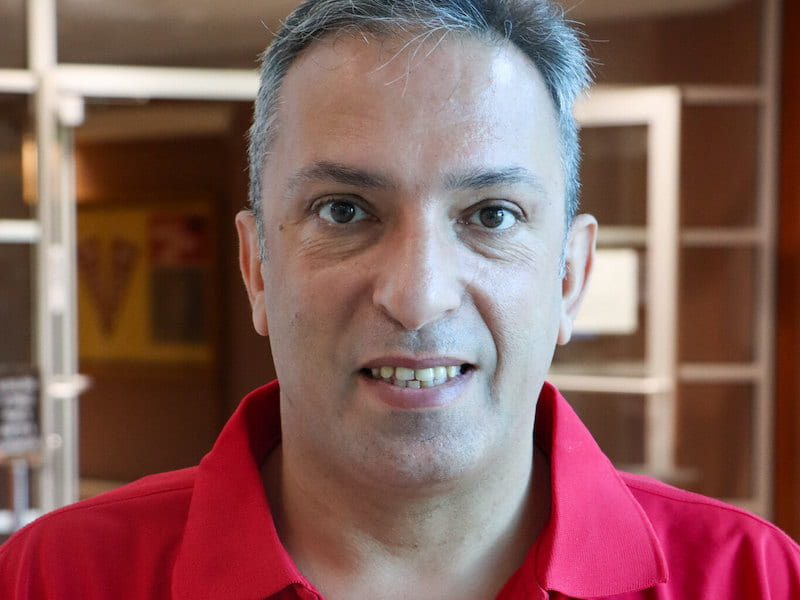
As the new resident director of the Livestock and Forestry Research Station near Batesville, Flint Harrelson brings more than two decades of experience in animal science. Harrelson is preparing to work with Jason Davis, precision agriculture extension specialist, on virtual fencing research.
As station director, Harrelson also oversees the livestock and forage research program, focusing on developing and identifying fescue-tolerant cattle through DNA mapping and epigenetics, and using forages and growth-promoting technology for stocker calf production.

Amir Mani is an assistant professor in the Department of Animal Science with a focus on microbiome and sustainability.
Gut health, antibiotic resistance, probiotics and the effects of bacteria on the immune system are specialties for Amir Mani, a new faculty member in the Department of Animal Science. As an assistant professor of microbiome and sustainability, Mani brings “an exceptional record of interdisciplinary research, including discoveries that reshape our understanding of gutsdfa-brain communication and antibiotic resistance transfer,” said Michael Looper, professor and head of the department.
Mani conducted his postdoctoral fellowship at the University of Chicago Pritzker School of Medicine after earning his doctorate in biology, focusing on microbiome and neuroimmune interactions, at the University of New Mexico.

Zena Herrera is an assistant professor of meat science and muscle biology in the Department of Animal Science.
Zena Herrera joined the Department of Animal Science in January as an assistant professor of meat science and muscle biology following two years in research and development with Tyson Foods.
Her expertise in fetal programming research will be helpful in Arkansas, where cow-calf operations make up a majority share of cattle farms, said Michael Looper, professor and head of the Department of Animal Science.
Herrera earned her doctorate in animal science from the University of Nebraska–Lincoln in 2023 and her master’s degree in animal science from Texas A&M University in 2020. She received her bachelor’s degree in animal science from the University of Arkansas.
Research Spotlights

Watermelon seedlings grow in pure food waste substrate, pure commercial peat moss-based potting mix, and blends of the two with varying ratios in a study to compare seedling germination, growth and nutrient uptake.
Horticulture and food science experts teamed up to study how food waste could possibly lay the foundation for growing the next bunch of crops.
- The study found that while food waste compost might not be viable as a standalone alternative to commercial potting mix, it could be suitable as part of a substrate mix.
- Compared to pure food waste compost, mixtures with less than 50 percent food waste compost produced better seedling emergence and growth and had better biomass accumulation.
Why it matters: Food waste makes up an estimated 30 to 40 percent of the United States’ food supply, according to the U.S. Food and Drug Administration.
- Matt Bertucci, assistant professor in the Department of Horticulture underscored the value of composting food waste, which he said prevents waste from going to landfill and offers a usable byproduct.
Watch
Asia Kud – Uncovering Nematode Resistance
Tiny nematodes are causing big problems for soybean growers in Arkansas. Asia Kud, assistant professor of entomology and plant pathology, studies plant-nematode interactions with a current focus on southern root-knot nematode, which is estimated to cause $100 million in soybean losses each year in Arkansas alone.
But it’s not just about plants — training the next generation of scientists is at the heart of Kud’s lab. “Coming here every day and seeing my team being as excited about science as I am, that’s really rewarding,” she said.
Hot off the Press

Arkansas Corn & Grain Sorghum Performance Tests 2025
Corn and grain sorghum performance tests are conducted each year in Arkansas to provide information to companies marketing seed within the state and to aid the Arkansas Cooperative Extension Service in formulating recommendations for producers.
Upcoming Events
Feb. 5, 2026
Non-Alcoholic Beer Research & Innovation Meeting
Fayetteville, Ark.
Registration: $75, closes on Feb. 7
Faculty in the News
Is your irrigation water sabotaging soybean yields?
Trent Roberts, Department of Crop, Soil and Environmental Sciences
Delta Farm Press
Study finds food waste compost less effective than potting soil alone
Matthew Bertucci, Department of Horticulture
High Plains Journal
Inside the quest to build the ultimate nonalcoholic beer
Scott Lafontaine, Department of Food Science
National Geographic
Pig Painkiller Patch Shows Promise
Jeremy Powell, Department of Animal Science
Farm Journal’s Pork Business
Voluntary wintertime cover crop adoption up 5% in Arkansas
Lanier Nalley, Department of Agricultural Economics and Agribusiness
Farm Talk News
Enjoying our newsletter? Sign up below to receive the Arkansas Agricultural Research Report in your inbox every month!
More Recent News