$425K NIFA Grant Supports Statewide Arkansas Weather Station Network
NIFA grant supports building statewide network of 20 high-tech weather stations
By John Lovett – Feb. 10, 2026

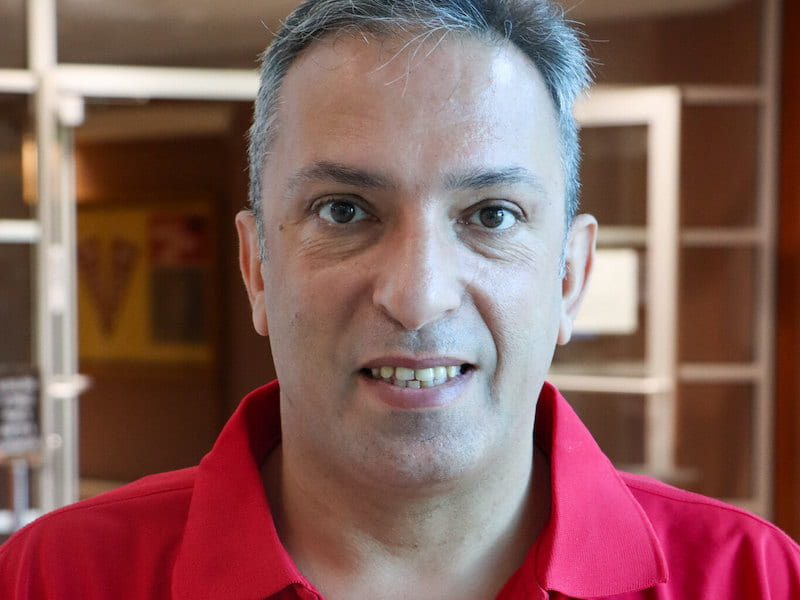
WEATHER STATION — Elvis Elli, an assistant professor of crop physiology in the department of crop, soil and environmental sciences, is coordinating the installation of high-tech weather stations across Arkansas. (UADA photo)
FAYETTEVILLE, Ark. — A statewide network of 20 high-tech weather stations is in the process of being built by the Arkansas Agricultural Experiment Station, thanks to a $425,000 grant from the U.S. Department of Agriculture’s National Institute of Food and Agriculture.
Once completed later this year, data from the weather stations will be publicly available on the University of Arkansas System Division of Agriculture website. The experiment station is the research arm of the Division of Agriculture.
The grant was awarded in December. Site locations are being determined at 13 Division of Agriculture research and extension centers and seven farms in the Arkansas Discovery Farms Program.
“Our goal is to make high-quality weather data available to our researchers and beyond,” said Elvis Elli, project coordinator and an assistant professor of crop physiology in the department of crop, soil and environmental sciences. “Having stations where most of the research is done will help correct the data that researchers rely on.”
Each location represents a unique microclimate, which can affect research analyses, Elli explained.
While each Division of Agriculture research and extension center currently has some form of weather recording equipment, the new stations will create a standard system across all locations, provide additional data points, and make multi-site trials easier to conduct, Elli added.
The Campbell Scientific UT30 weather station was selected for the project. The stations will stand about 30 feet tall atop a concrete base and will come with network-enabled measurement and control dataloggers.
Each weather station will be powered by a local source or solar power and hourly record air temperature at three heights, relative humidity, solar radiation, photosynthetically active radiation, wind speed and direction, soil temperature and moisture at two depths, rainfall, leaf wetness, and sunset and sunrise times.
Weather data is used for many things in agricultural research, including irrigation management, crop modeling, carbon cycle studies, and forecasting to manage pests, weeds and pathogens. Other uses include research on climate change and water quality, as well as tying remote-sensing data from satellites to local conditions.
Publicly available
Data from the weather stations will be made publicly available at weatherstation.uada.edu, a website currently recording multiple weather data points at the Milo J. Shult Agricultural Research and Extension Center in Fayetteville.
Karen Watts DiCicco, the chief information security officer and director of business enablement and enterprise applications for the Division of Agriculture, will oversee the application development team as a collaborator on the weather station project. As each new station goes live, DiCicco’s team will add its information to the site so everyone can view the data in one place, she said.
Project origin
Mary Savin, professor and head of the department of horticulture for the Division of Agriculture and the Dale Bumpers College of Agricultural, Food and Life Sciences, initiated the weather station project several years ago and is also a collaborator on the current project, which she says will benefit research in a wide range of academic disciplines.
“I am very excited that Dr. Elli and a multitude of colleagues have had the support of UADA administration and have successfully pursued federal grant funding to enhance Arkansas’ weather data collection and data management capabilities,” Savin said.
Over the years, as a faculty member and then an assistant director for the experiment station, Savin said she heard from researchers across many disciplines that reliably obtaining consistent and complete weather data throughout the state of Arkansas has been an ongoing challenge.
“Researchers have been limited by a lack of robust, networked weather stations with easily downloadable data,” Savin said. “This grant is an excellent example of an award that will support many of UADA’s departments and their land-grant mission for the benefit of stakeholders throughout Arkansas’ communities and industries.
“Field equipment that will be installed throughout the state, along with data and web management infrastructure, will facilitate access to data to support new knowledge and facilitate better decision-making for the management of our natural ecosystems. This project also opens opportunities for education and development of the workforce in Arkansas to be better problem-solvers to address complex issues confronting the state.”
Outreach component
Project collaborators who have appointments in the Cooperative Extension Service, the outreach arm of the Division of Agriculture, will train agricultural teachers and extension agents on how to use the weather data.
Extension surveys will also be conducted with producers in the Arkansas Discovery Farms Program to quantify the impact on informed decision-making.
Faculty with the department of agricultural education, communications, and technology will lead efforts to share data and create programming to improve knowledge among the public and industry professionals, Elli said.
The project’s collaborators include:
- Matthew Bertucci, assistant professor of sustainable fruit and vegetable production in the department of horticulture.
- Kristophor Brye, University Professor of applied soil physics and pedology in the department of crop, soil and environmental sciences.
- Mike Daniels, Distinguished Professor and extension soil and water conservation scientist with the Division of Agriculture’s Cooperative Extension Service and director of the Arkansas Discovery Farms Program.
- Christopher Estepp, professor in the department of agricultural education, communications and technology.
- Brian Haggard, professor in the department of biological and agricultural engineering and director of the Arkansas Water Resources Center.
- Steve Green, professor of soil and water conservation at Arkansas State University.
- Neelandra Joshi, professor of entomology in the department of entomology and plant pathology.
- Cengiz Koparan, assistant professor of precision agriculture technology with the department of agricultural education, communications and technology and the department of biological and agricultural engineering.
- Jefferson Miller, assistant dean for international programs for Bumpers College and professor with the department of agricultural education, communications, and technology.
- Dirk Philipps, associate professor of forages in the department of animal science.
- Mike Richardson, professor of turfgrass science in the department of horticulture.
- Trenton Roberts, professor of soil fertility and soil testing for the department of crop, soil and environmental sciences and Endowed Chair in Soil Fertility Research.
- Benjamin Runkle, associate professor of biological and agricultural engineering for the College of Engineering at the University of Arkansas.
This work is supported by the Equipment Grant Program, project award no. 2025-70410-45354, from the U.S. Department of Agriculture’s National Institute of Food and Agriculture.
Mention of product names does not imply endorsement by the University of Arkansas System Division of Agriculture.
To learn more about ag and food research in Arkansas, visit aaes.uada.edu. Follow the Arkansas Agricultural Experiment Station on LinkedIn and sign up for our monthly newsletter, the Arkansas Agricultural Research Report. To learn more about the Division of Agriculture, visit uada.edu. To learn about extension programs in Arkansas, contact your local Cooperative Extension Service agent or visit uaex.uada.edu.
About the Division of Agriculture
The University of Arkansas System Division of Agriculture’s mission is to strengthen agriculture, communities, and families by connecting trusted research to the adoption of best practices. Through the Agricultural Experiment Station and the Cooperative Extension Service, the Division of Agriculture conducts research and extension work within the nation’s historic land grant education system.
The Division of Agriculture is one of 20 entities within the University of Arkansas System. It has offices in all 75 counties in Arkansas and faculty on three campuses.
Pursuant to 7 CFR § 15.3, the University of Arkansas System Division of Agriculture offers all its Extension and Research programs and services (including employment) without regard to race, color, sex, national origin, religion, age, disability, marital or veteran status, genetic information, sexual preference, pregnancy or any other legally protected status, and is an equal opportunity institution.
More Recent News